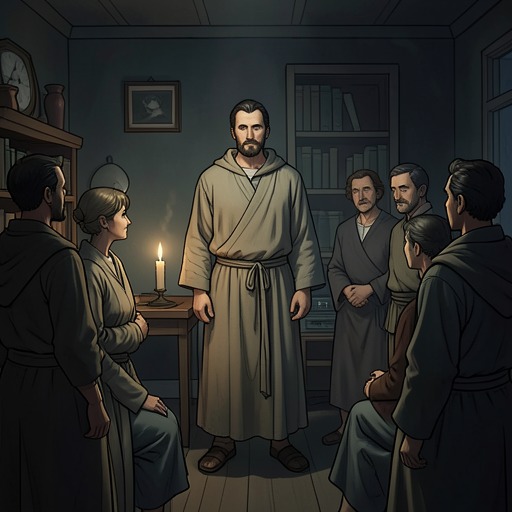
Danjel opens Kärragärde to the poor and outcasts
The EmigrantsDanjel’s opening of Kärragärde to poor people and social outcasts transforms his household into a shared refuge and brings his religious convictions into public view. When Karl Oskar visits to borrow money for a mortgage payment, he finds not simply a charitable host but a household reorganized around people whom the parish’s systems classify and regulate. Danjel still lends the money, but no longer accepts interest; soon, word spreads that the teachings of Åke Svensson have been revived.
A household opened to outsiders
The change comes into focus when Karl Oskar visits Kärragärde to borrow fifty daler for mortgage interest. The house is full of people, including the household’s own members and strangers seated at the table. Among them are Severius Pihl, a dishonorably discharged soldier known for fighting and drunkenness; Sissa Svensdotter, a disabled maid and impoverished thief dependent on parish support; and Ulrika of Västergöhl, a former sex worker, with her illegitimate daughter. Karl Oskar initially assumes that the visitors have arrived together while begging. Danjel then tells him that they will live at Kärragärde from now on, and Inga-Lena confirms that they are all staying there.
The welcome is enacted in ordinary household work as well as in Danjel’s declaration. The family has slaughtered animals, and Inga-Lena is boiling blood sausage for the guests. When Kristina hears Karl Oskar’s account, she at first laughs, taking the story for an October version of an April-fool joke. The details gradually make the change harder to dismiss: these are not merely people who have stopped for food, but people the household has chosen to receive as its own.
Poverty and the parish’s order
The people gathered at Kärragärde belong to a wider population recorded in the parish book: farm servants, squatters, poor people, and residents described as sick, disabled, blind, or otherwise unable to support themselves. Parish relief divided those needing assistance into groups. People entirely incapacitated could receive “complete sustenance,” which might include up to three riksdaler a year and four bushels of barley; those partly disabled received smaller sums and, at most, two bushels. Temporary help came from the Ljuder Parish Poor Purse, whose aid could also be restricted for people the council judged responsible for their own poverty.
Against this graded system of official relief, Danjel’s decision is striking for its domestic intimacy: he brings people into his home, seats them at the family table, and has Inga-Lena prepare food for them. The evidence does not set out a formal alternative system of communal support, but the household’s practice does cross the boundary between occasional alms and an enduring place to live. Kärragärde becomes a response to exclusion made through shared residence and hospitality.
Lending without interest
The visit also reveals that Danjel’s change reaches beyond whom he welcomes. When Karl Oskar asks for fifty daler, Danjel provides the full amount. But when Karl Oskar asks whether they should calculate interest as before, Danjel says that he no longer wants interest on money he lends. He also refuses to take interest on the older debt, repeating his decision for clarity.
This reversal matters in a family already burdened by debt. When Karl Oskar took over Korpamoen, the purchase price was seventeen hundred riksdaler, including an eight-hundred-riksdaler mortgage. His parents, Nils and Märta, retained rights to housing, fodder, land, and grain for the rest of their lives. Although Karl Oskar and Kristina labored for three years, they ended that period with one fewer cow and seventy riksdaler more debt. Danjel had previously helped by lending the fifty riksdaler needed for mortgage interest; now the same act of assistance is recast as a loan without the customary charge. His conduct contrasts with a local economy in which maintaining a farm and honoring family obligations can deepen rather than relieve hardship.
Religious change and public consequence
Danjel’s hospitality and refusal of interest lead Karl Oskar to conclude that something serious has happened to his uncle. He guesses that Danjel may have suffered a mental disturbance, while Kristina becomes concerned about what is taking place at Kärragärde. Their uncertainty registers how far the household’s new arrangement departs from familiar expectations, before its religious meaning becomes publicly named.
Within days, rumors travel from house to house and village to village: the heresy associated with Åke Svensson, believed to have died with its founder more than fifty years earlier, has been revived by his sister’s son at Kärragärde. Danjel’s household thus becomes more than a private refuge. By receiving people whom parish society marks as burdensome or disreputable, and by abandoning interest on his loans, he gives practical form to a religious break that the surrounding community identifies as Åkian. The act joins material need and belief: welcome is expressed not only in doctrine, but in who is permitted to live under the same roof and what is no longer demanded of a borrower.